



Take a look around the 2026 legal landscape. The gap between a firm that is merely “profitable” and one that absolutely dominates its market comes down to a single metric: Operational Velocity in modern personal injury law firm operations. Insurance adjusters are heavily relying on their own AI models to devalue claims systematically. If your firm is still relying on slow, manual drafting, you’re bringing a knife to a gunfight. You have to respond with a superior, data-backed offence.
At The Allied Outsourcing, we provide a specialised remote support extension that transforms the labour-intensive settlement demand process into a high-precision assembly line. By marrying elite, US-based PI expertise with cutting-edge Agentic Workflows, we don’t just shrink your overhead – we amplify your firm’s authority at the negotiation table.
Here is exactly how powerhouse PI firms are engineering their demands this year.
Table of Contents
The Anatomy of a High-Authority Personal Injury Demand Package
A mediocre demand is just a letter. A high-authority demand is a litigation-ready dossier. Our evolved workflows ensure every single package leaving your firm contains:
● Executive Summary Dashboards: Did you know adjusters spend an average of just 6 minutes reviewing a demand? You can’t bury the numbers. We lead with a “Stat-at-a-Glance” header—highlighting total specials, permanent impairment ratings, and a clear settlement “anchor” figure right at the top.
● Agentic Medical Chronologies: Traditional summaries are often bloated and hard to read. Our AI agents are specifically programmed to extract “Value-Drivers”—such as mentions of loss of consortium, limitations on “activities of daily living” (ADLs), and future care requirements. The AI cross-references these details instantly across thousands of pages of records, improving medical chronology preparation for personal injury cases.
● Visual Proof & Pinterest-Style Aesthetics: We integrate cinematic, HDR-quality photographic evidence directly into the layout. Whether it’s a post-op surgical site or a property damage shot, clear, high-resolution visuals force an adjuster to acknowledge severity in a way a grainy scan never could.
Case Study: Scaling Personal Injury Law Firms Without Hiring Burnout
Let’s look at a real-world scenario.
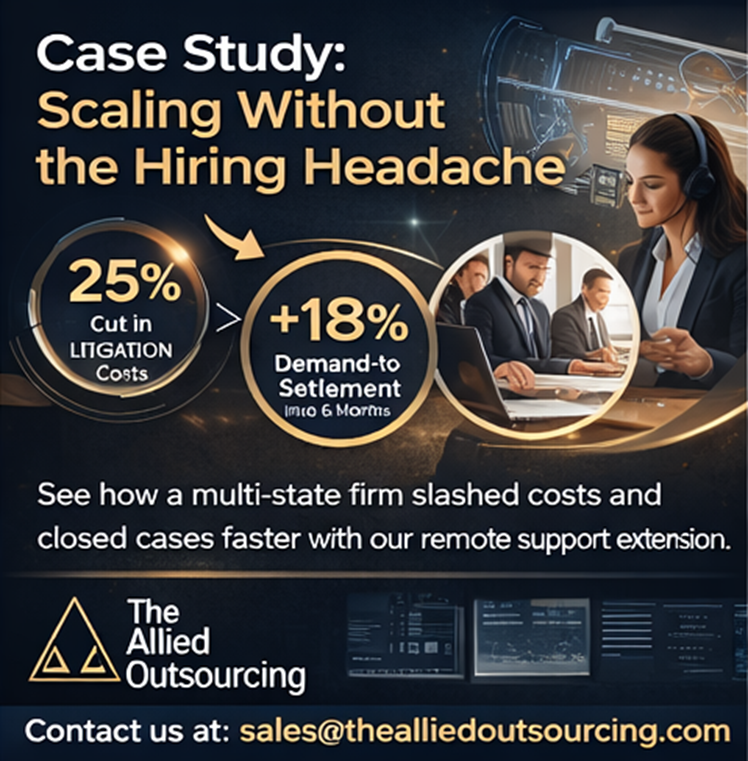
The Challenge: A multi-state PI firm came to us facing a 25% increase in litigation costs due to “administrative drift.” Their highly paid paralegals were wasting 60% of their day chasing medical records and doing basic drafting, rather than focusing on trial prep.
The Allied Outsourcing Solution: We seamlessly integrated our dedicated Specialised Remote Support Team directly into their existing Case Management Software (CMS).
The Workflow: As soon as a “Meds Complete” trigger was received in their CMS, our remote team automatically initiated the indexing and drafting sequence.
The Result: The firm reduced its internal “Cost-Per-Demand” from $1,800 down to just $850. Even better? By offloading the prep work to our experts, the firm’s senior attorneys were freed up to negotiate, increasing their “Demand-to-Settlement” ratio by 18% in just six months.
Leveraging AI in Personal Injury Demand Drafting
A lot of people throw the word “AI” around, but we build AI Agents. Think of these as autonomous digital workers designed to execute complex, multi-step legal tasks with 99.9% accuracy.
● The “Gap-Finder” Agent: This acts as your digital safety net. It scans medical records against the initial police report. If your client complained of “neck pain” at the scene, but the ER records only mention “back pain,” the agent immediately flags the discrepancy for the attorney before the demand is sent out.
● The Billing Auditor: Insurance software like “Colossus” loves to pick apart bills. Our tech team leverages AI to cross-reference medical bills against the “Reasonable and Customary” (UCR) rates for that specific zip code, ensuring your demand is ironclad and resistant to software-driven lowball offers.
The Cost Advantage of Legal Process Outsourcing for PI Firms
Let’s talk numbers. In 2026, a high-tier US paralegal or junior associate can easily cost you $80,000 to $120,000 annually—and that’s before factoring in benefits, taxes, and office space.
The Allied Outsourcing Value Proposition: When you utilise our specialised remote extension, you shift your firm from a risky Fixed Cost model (salaries) to an agile Variable Cost model.
● No Recruitment Costs: We handle the sourcing. You get experts with years of US PI experience on day one.
● Zero Tech Overhead: You gain full access to our experienced tech team and proprietary AI tools without paying a dime in R&D.
● Unmatched Consistency: Our workflows are standardised, simple, and reliable. There are no “sick days” or turnover disruptions delaying your demand pipeline.
Future-Proofing Personal Injury Law Firm Operations in 2026
To dominate your local market, your firm’s digital content and operational efficiency must reflect this level of sophistication. For maximum Personal Injury Operating Efficiency, firms need to focus on integrating:
● Scalable Litigation Support
● Remote PI Case Management
● AI-Automated Demand Drafting
“Firms that fail to automate the ‘Discovery-to-Demand’ pipeline by mid-2026 will face a 30% margin erosion due to rising labour costs and insurance carrier delays.” — Industry Insight.
Run This 2026 Efficiency Audit for Your PI Law Firm
The 2026 PI Firm Efficiency Audit: Your Blueprint for a 50% Cost Reduction
To achieve a 50%+ reduction in operating costs while scaling your firm’s output, you must move from “manual management” to “Agentic Workflows.” This audit is designed for The Allied Outsourcing partners to identify high-cost leaks and automation opportunities.
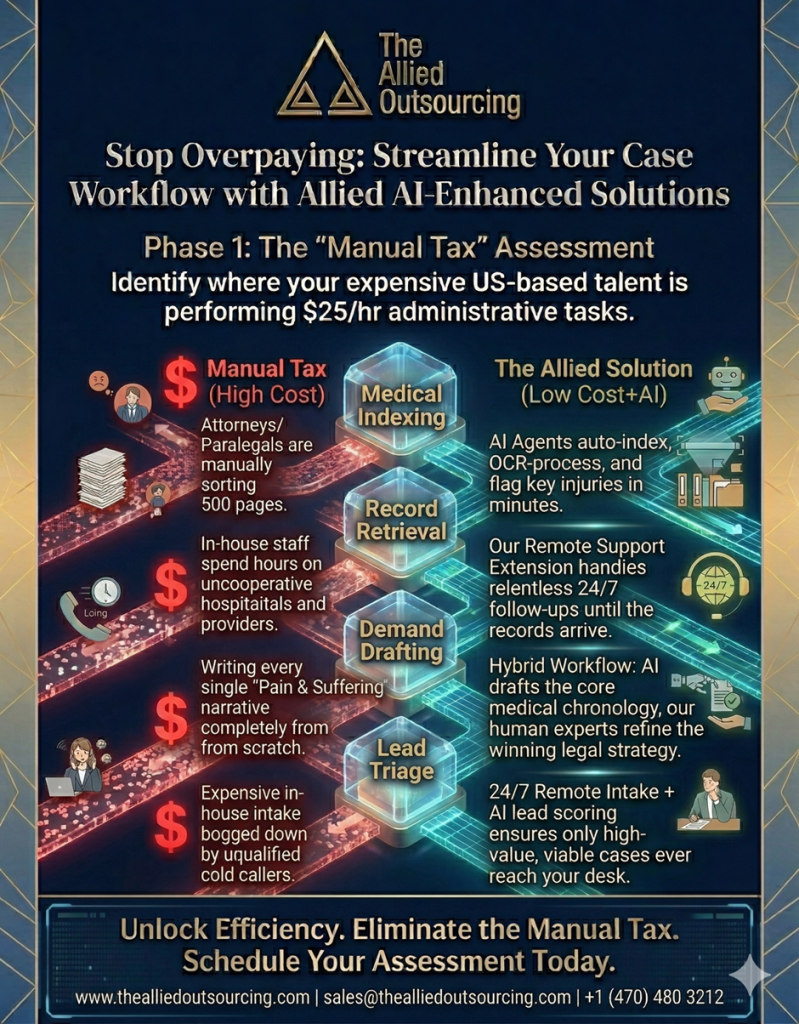
Phase 1: The “Manual Tax” Assessment
Identify where your expensive US-based talent is performing $25/hr administrative tasks.
| Workflow Area | The Manual Tax (High Cost) | The Allied Solution (Low Cost+AI) |
| Medical Indexing | Attorneys/Paralegals are manually sorting 500+ pages. | AI Agents auto-index, OCR-process, and flag key injuries in minutes. |
| Record Retrieval | In-house staff spend hours on hold with uncooperative hospitals and providers. | Our Remote Support Extension handles relentless 24/7 follow-ups until the records arrive. |
| Demand Drafting | Writing every single “Pain & Suffering” narrative completely from scratch. | Hybrid Workflow: AI drafts the core medical chronology; our human experts refine the winning legal strategy. |
| Lead Triage | Expensive in-house intake staff bogged down by unqualified cold callers. | 24/7 Remote Intake + AI lead scoring ensures only high-value, viable cases ever reach your desk. |
Phase 2: Operational KPI Audit (The 2026 Standard)
If you aren’t obsessively tracking these four metrics, you are almost certainly overpaying for your outcomes. Let’s look at the benchmarks powerhouse firms are hitting this year.
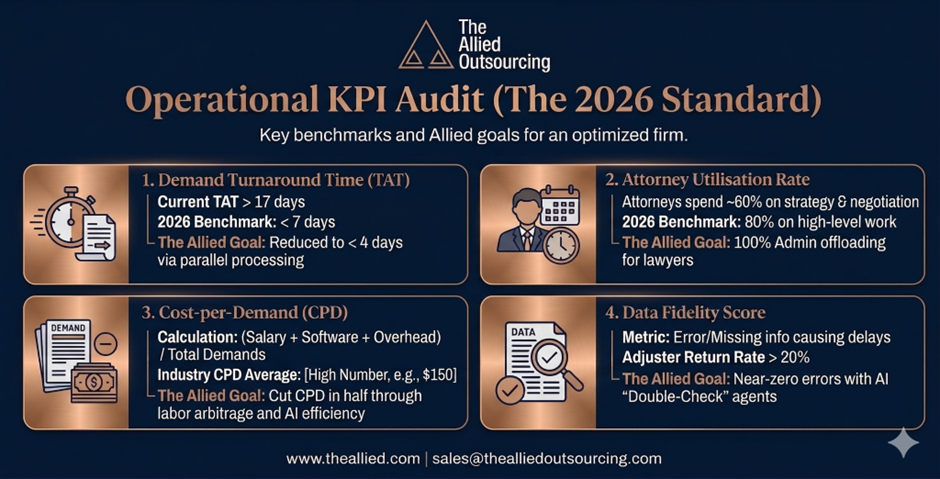
- Demand Turnaround Time (TAT)
● The 2026 Benchmark: Less than 7 days from the “Treatment Complete” date to the “Demand Sent” date.
● The Allied Goal: We help you reduce your current TAT by 60% by utilising parallel remote processing. - Attorney Utilisation Rate
● The 2026 Benchmark: Are your attorneys actually spending 80% of their day on high-level litigation strategy and negotiation?
● The Allied Goal: We offload 100% of the administrative “grunt work” to our remote extension, freeing your lawyers to actually practice law. - Cost-per-Demand (CPD)
● The Calculation: (Staff Salary + Software + Overhead) ÷ Total Demands Sent.
● The Allied Goal: Cut your CPD in half through specialised remote labour arbitrage and AI efficiency. - Data Fidelity Score
● The Metric: The percentage of demand packages returned or delayed by adjusters simply because of “missing info.”
● The Allied Goal: Near-zero errors. We achieve this by deploying AI-driven “Double-Check” agents before anything leaves our desk.
Phase 3: The Allied Outsourcing “Agentic” Implementation Checklist
Take a hard, honest look at your current operations. Check every box that currently applies to your firm. If you have more than three ‘No’s on this list, your operating costs are easily 50% higher than they should be.
● Automated Chronologies
● Remote Staff Integration
● 24/7 Workflow Continuity
● Predictive Settlement Modelling
● Standardised “Pinterest-Style” Exhibits
Conclusion: Turn Your Demand Process Into a Revenue Engine
Settlement demand preparation is no longer just an administrative task—it’s a strategic growth lever for personal injury law firms.
Firms that adopt:
- AI-powered demand drafting
- medical chronology outsourcing
- legal process outsourcing support
- standardized workflows
are seeing improvements in:
- demand turnaround time
- settlement efficiency
- operational cost reduction
- case handling capacity
The shift is clear: high-performing PI firms are building systems, not just teams.
Scale Your Demand Pipeline Without Increasing Overhead
The Allied Outsourcing helps personal injury law firms modernize their demand process with:
✔ AI-assisted demand drafting
✔ Medical record review & chronologies
✔ Discovery & case management support
✔ Dedicated remote legal support teams
Book a Free Consultation
If you want to improve settlement outcomes, reduce operational costs, and handle more cases without hiring burnout, our team can walk you through a tailored workflow. Email: sales@thealliedoutsourcing.com | Call Us: +1 (470) 480-3212 | Visit our website: thealliedoutsourcing
Frequently Asked Questions
What is a personal injury demand package?
A demand package is a structured document sent to insurance companies outlining injuries, treatment, damages, and settlement expectations to initiate negotiations.
How do AI demand letters improve settlement outcomes?
AI helps structure medical data, extract billing details, and create consistent drafts, allowing attorneys to present stronger, data-backed demands.
What is legal process outsourcing for PI firms?
It involves delegating tasks like medical record review, demand drafting, and case management to specialized teams to improve efficiency and reduce costs.
Can outsourcing demand drafting reduce turnaround time?
Yes. Specialized teams and AI workflows significantly reduce preparation time, often delivering demand packages much faster than manual processes.
How can PI law firms scale without increasing costs?
By combining AI automation with remote legal support teams, firms can increase case capacity while keeping operational costs under control.