


Table of Contents
Scale a personal injury law firm in 2026 looks very different from how it worked just a few years ago.
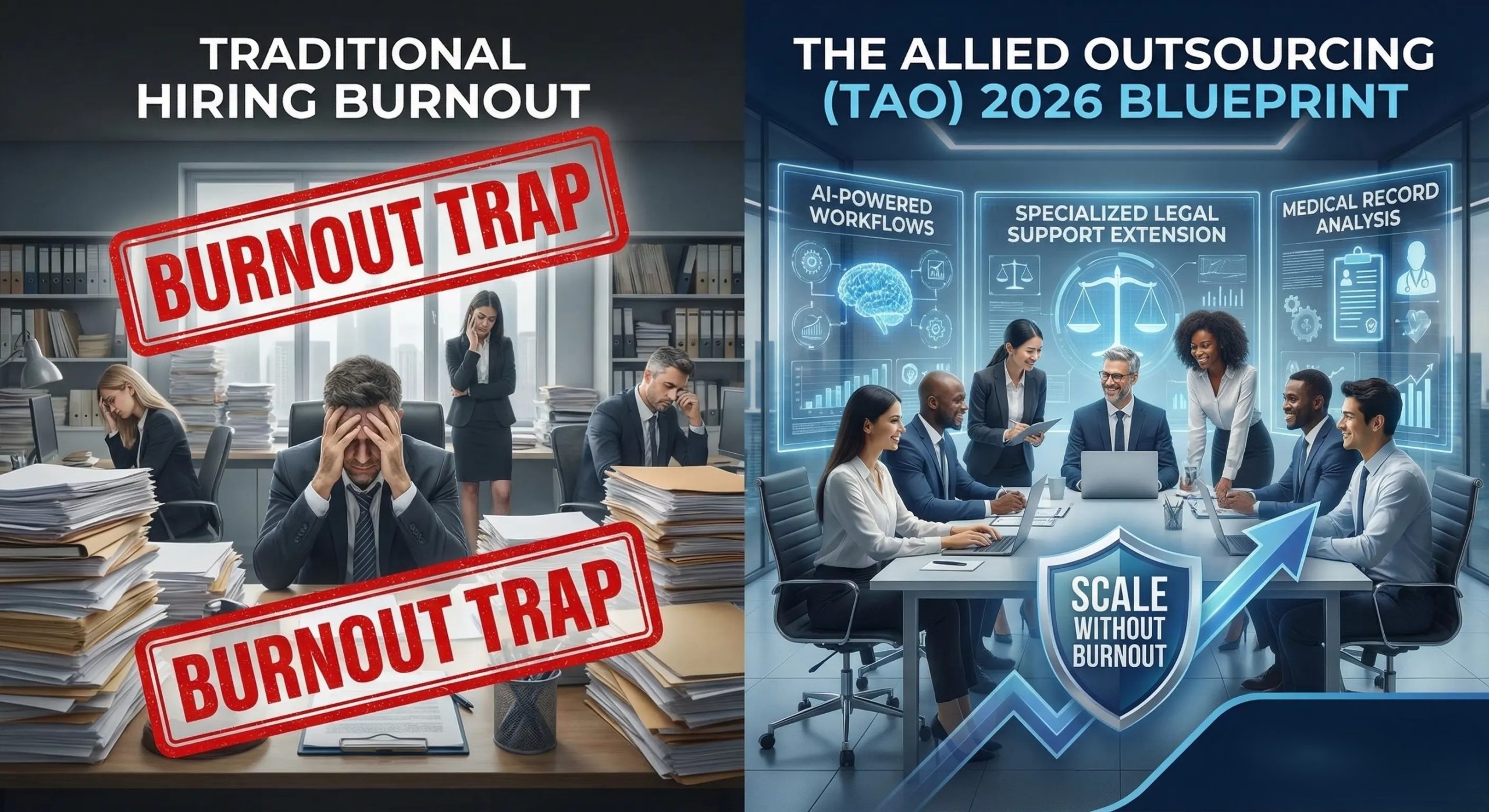
Traditionally, growth meant hiring more paralegals, expanding office space, and increasing overhead. But today, many personal injury firms are facing a new challenge — growth is creating operational stress instead of profitability.
This is often called the “hiring burnout trap.”
You sign more cases, but instead of scaling smoothly, your team becomes overwhelmed with:
- medical records and documentation
- demand package preparation
- discovery and case administration
- client communication and follow-ups
As case volume increases, so do delays, errors, and internal pressure.
The firms that are scaling successfully in 2026 are not simply hiring more people. They are adopting a different model — AI-powered workflows combined with specialized legal process outsourcing (LPO) support.
Why Hiring More Staff Is No Longer a Scalable Model
For many personal injury law firms, hiring has become increasingly difficult and expensive.
Common challenges include:
- high recruitment and onboarding costs
- months of training before productivity
- employee turnover and retraining cycles
- burnout during peak caseload periods
Even well-managed firms struggle to maintain efficiency when relying entirely on in-house teams.
As a result, scaling through hiring alone often leads to:
- slower case turnaround times
- inconsistent quality in documentation
- increased operational costs
- reduced profit margins
This is why many firms are now exploring alternative operational models that allow them to grow without increasing internal complexity.
The Remote Legal Support Extension Model for PI Firms
Modern personal injury law firms are increasingly adopting a Remote Legal Support Extension model.
Instead of traditional outsourcing, this approach involves working with specialized teams that function as an extension of your firm’s operations.
These teams are trained specifically in personal injury workflows, including:
- medical record review and organization
- medical chronology preparation
- demand letter drafting
- discovery document support
- case management assistance
- lien tracking and documentation
When integrated with case management systems like Clio or Filevine, these teams operate seamlessly alongside in-house staff.
Key Advantages of the Extension Model
Faster onboarding
Teams already understand PI case workflows, reducing training time.
Scalable capacity
Firms can handle higher case volumes without hiring additional full-time staff.
Operational consistency
Standardized processes ensure uniform quality across all cases.
This model allows firms to increase output while maintaining control over legal strategy and client relationships.
AI Automation in Personal Injury Case Management
AI is becoming an essential component of modern personal injury law firm operations.
However, the most effective firms are not using AI in isolation — they are combining it with human legal expertise.
AI-powered workflows can support:
- medical record analysis
- billing data extraction
- ICD-10 code identification
- treatment timeline generation
- demand letter drafting
Example: AI-Assisted Demand Workflow
With the right systems in place, personal injury firms can:
- extract medical billing data instantly
- identify gaps in treatment early
- flag pre-existing conditions
- generate structured demand drafts
This significantly reduces the time required to prepare demand packages.
At the same time, experienced legal professionals review and refine these outputs to ensure:
- accuracy
- compliance
- strategic alignment
This AI + human hybrid approach allows firms to improve both speed and quality.
Systems Over Chaos: Standardizing Personal Injury Workflows
Many personal injury firms rely heavily on internal processes that exist only in the knowledge of specific team members.
This creates risk and inefficiency.
Examples include:
- inconsistent medical record organization
- delays in identifying treatment gaps
- reliance on individual staff members for critical tasks
To scale effectively, firms need standardized and repeatable workflows.
Well-designed operational systems provide:
- consistent case handling
- faster turnaround times
- improved visibility across cases
- reduced dependency on individual employees
This shift from people-dependent operations to process-driven workflows is critical for long-term growth.
The Cost Advantage: Scaling Without Increasing Overhead
One of the biggest benefits of adopting AI workflows and legal process outsourcing is cost efficiency.
Instead of increasing fixed costs through hiring, firms can use flexible operational support.
| Expense Area | Traditional Model | Modern Extension Model |
| Hiring & Training | High cost and time investment | Pre-trained legal support teams |
| Technology | Multiple tools and licenses | Integrated systems and workflows |
| Management | Heavy internal supervision | Managed processes with QA |
| Turnaround Time | Weeks for chronologies | Faster delivery through automation |
Many firms experience:
- reduced operational costs
- faster case processing
- improved scalability
This allows firms to allocate resources toward marketing, litigation strategy, and client acquisition.
The Future of Scale a Personal Injury Law Firms
The most successful personal injury firms in the coming years will focus on:
Operational tasks such as documentation, record review, and administrative workflows will increasingly be handled through AI-supported systems and specialized legal support teams.
This enables firms to:
- handle higher case volumes
- reduce delays in case preparation
- improve overall efficiency
- maintain consistent quality
Scaling is no longer about building larger internal teams — it’s about building smarter operational systems.
Scale Your Personal Injury Law Firm Without Hiring Burnout
Many Personal Injury Law firms today are looking for ways to grow without increasing internal pressure on their teams.
The Allied Outsourcing supports personal injury law firms with:
✔ Medical record review and organization
✔ Medical chronology preparation
✔ AI-assisted demand drafting
✔ Discovery and case management support
✔ Scalable legal support teams aligned with your workflow
Our approach combines technology, process, and experienced legal professionals to help firms improve operational efficiency and handle larger case volumes.
Book a Free Workflow Consultation
If you are exploring ways to scale your personal injury practice without increasing hiring costs, our team can walk you through a customized workflow approach. Email Us: sales@thealliedoutsourcing.com or you can call us +1 (470) 480-3212 or you can visit The Allied Outsourcing.
Frequently Asked Questions
How can a personal injury law firm scale without hiring more staff?
Personal injury law firms can scale by using legal process outsourcing (LPO) and AI-powered workflows to handle operational tasks such as medical record review, demand drafting, and case management support. This reduces dependency on internal hiring while increasing efficiency.
What is a remote legal support extension team?
A remote legal support extension team is a specialized external team that works alongside a law firm to handle operational tasks. Unlike traditional outsourcing, these teams are trained in personal injury workflows and integrate directly with the firm’s processes.
How is AI used in personal injury law firms?
AI is used to automate repetitive tasks such as medical record analysis, billing data extraction, and demand drafting. It helps reduce manual workload while improving accuracy and turnaround time.
Is legal process outsourcing safe for personal injury cases?
Yes, when implemented with proper security protocols and compliance standards such as HIPAA, legal process outsourcing can safely handle sensitive case data. Many firms also use human verification to ensure accuracy.
What are the benefits of outsourcing medical chronologies?
Outsourcing medical chronologies allows law firms to receive structured treatment timelines faster, identify key medical events, and improve demand preparation without overloading internal staff.