

The gap between a struggling personal injury firm and a market leader in 2026 isn’t measured in billboard spend. It’s measured in the sophistication of the technology running behind the scenes.
The legal industry has quietly moved past “AI adoption” into something more meaningful: AI augmentation in personal injury law firms. And the firms landing the biggest settlements aren’t necessarily the largest ones — they’re the ones that have replaced manual bottlenecks with intelligent, automated workflows.
At The Allied Outsourcing, we don’t just watch this shift happen. We build the infrastructure that drives it. As a specialised remote support extension for US-based PI law firms, we bring together deep domain expertise and a high-performance tech team to create the “engine room” that powers modern litigation.
The outcome? Operating costs cut by 50% or more, and a meaningful, firm-wide jump in productivity. Here’s what that modern personal injury law firm tech stack actually looks like.
Table of Contents
The Foundation: Cloud-Native Case Management Systems
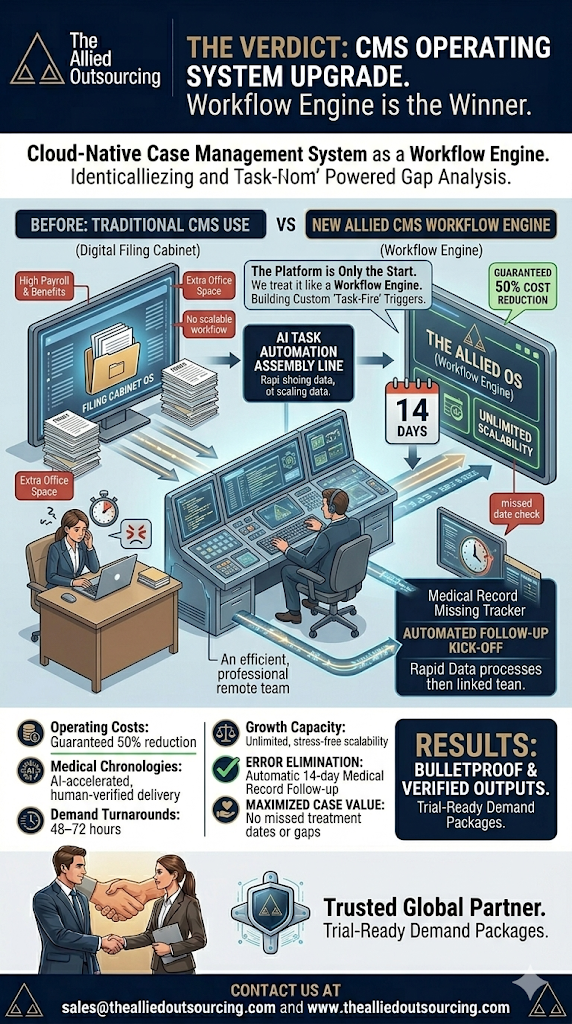
Every strong tech stack starts with a solid core, and in 2026, that means a cloud-native case management system. Leading firms have moved to platforms like Filevine, Litify, or Neos — but the platform alone isn’t the point.
Where The Allied Outsourcing makes the difference: Most firms use their CMS like a digital filing cabinet. We treat it like a workflow engine. Our team builds custom “task-fire” triggers that keep every case moving. If a medical record hasn’t arrived within 14 days, an automated follow-up kicks off immediately — eliminating the kind of human error that leads to treatment gaps and lost case value.
Agentic AI for Medical Record Review & Chronology Automation
Ask any PI paralegal what eats up their week, and medical record review is almost always the answer. A 1,000-page file can take 10 to 15 hours to index manually. That’s the time your team doesn’t have.
Agentic AI fundamentally changes that math. Unlike basic AI tools that scan for keywords, these agents actually reason through a document — identifying causation, spotting inconsistencies, and connecting the dots across hundreds of records.
In practice: We deploy agents that can ingest 5,000+ pages of unstructured hospital records and produce a fully hyperlinked medical chronology — almost instantly.
The real-world result: In a recent case study, a firm using our AI-driven indexing cut its “Time-to-Demand” by 70%, enabling it to file demands months ahead of competitors working the same case type.
Automated Demand Packages & Treatment Gap Monitoring
The demand package is arguably the most important document in any PI case. Yet for most firms, pulling one together is still a multi-day, manual process. It doesn’t have to be.
Treatment gap monitoring: Our AI agents check provider portals every day. If a client misses an appointment, the team is alerted immediately. Staying on top of treatment continuity is one of the most effective ways to protect case value — and it’s something most firms can’t do consistently without automation.
Dynamic drafting: Using large language models fine-tuned on US PI law, we generate initial demand drafts — complete with ICD-10 codes, pain-and-suffering narratives, and precise special damages calculations — in under 20 minutes.
24/7 AI-Powered Intake and Lead Conversion for PI Firms
About 79% of law firms are now using AI in some form, and intake is one of the highest-stakes areas to get right. A potential client who reaches out at 2 AM and doesn’t hear back is already calling someone else by morning.
How we handle it: We integrate AI-driven intake bots that qualify leads based on your firm’s specific criteria — jurisdiction, liability, insurance minimums — and get a consultation on your calendar before the claimant ever leaves your website. No follow-up delay. No missed opportunity.
Why Personal Injury Law Firms Scale with The Allied Outsourcing
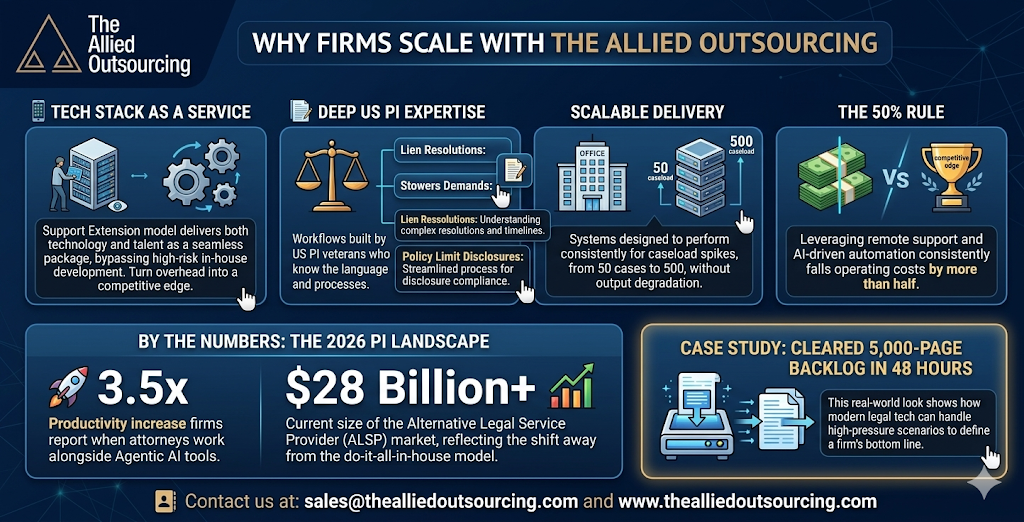
Building this kind of tech stack from scratch is expensive, slow, and high-risk. Our “Support Extension” model delivers both the technology and the talent as a seamless package — without the overhead of building it in-house.
Deep US PI expertise: Our workflows are built by people who have supported US PI firms for years. We know the language — Lien Resolutions, Stowers Demands, Policy Limit Disclosures — and we build processes around it.
Consistent, reliable delivery: Our systems are designed to perform at the same level whether your firm is handling 50 cases or 500. Caseload spikes don’t degrade output quality.
The 50% rule: Clients who leverage our remote support team and AI-driven automation consistently see operating costs fall by more than half. We help you turn overhead into a competitive edge.
By the Numbers: The 2026 Personal Injury Law Firm Landscape
- 3.5x — the productivity increase firms report when attorneys work alongside Agentic AI tools
- $28 Billion+ — the current size of the Alternative Legal Service Provider (ALSP) market, reflecting how many firms have moved away from the high-cost, do-it-all-in-house model
Real Case Study: AI-Powered Medical Record Review at Scale
How AI Agents Cleared a 5,000-Page Backlog in 48 Hours — A Real-World Look at What Modern Legal Tech Can Do
Some of the most compelling proof points don’t come from demos or pitch decks — they
come from the kind of high-pressure situations that define a firms bottom line.
This is one of those stories.
The Firm and the Problem
A Texas-based personal injury firm specialising in Medical Malpractice and Motor Vehicle Accident (MVA) cases came to The Allied Outsourcing with a challenge that will sound familiar to anyone who has worked in plaintiff-side litigation: an overwhelming volume of unstructured medical records and a deadline that wouldn’t wait.
The case involved a catastrophic injury. Across 12 different providers, the firm had accumulated over 5,000 pages of documentation — handwritten ER notes, inconsistent radiology reports, conflicting billing codes, and physician handwriting that bordered on illegibility. A senior paralegal estimated it would take roughly three weeks to index everything and manually produce a usable chronology.
They didn’t have three weeks.
A deposition was approaching. And buried somewhere in those 5,000 pages was a critical detail about a pre-existing condition — a “smoking gun” that could define the outcome of the case. The attorney needed to find it before the defence did.
The Challenge at a Glance
- Volume: 5,000+ pages of medical records spanning 12 providers
- Complexity: Illegible handwriting, inconsistent billing codes, and conflicting clinical Documentation.
- Stakes: A looming deposition with a time-sensitive evidentiary issue hanging in the Balance
This is the kind of situation where traditional manual review doesn’t just slow you down it puts the case at risk.
The Allied Outsourcing Solution: A Multi-Agent AI Workflow
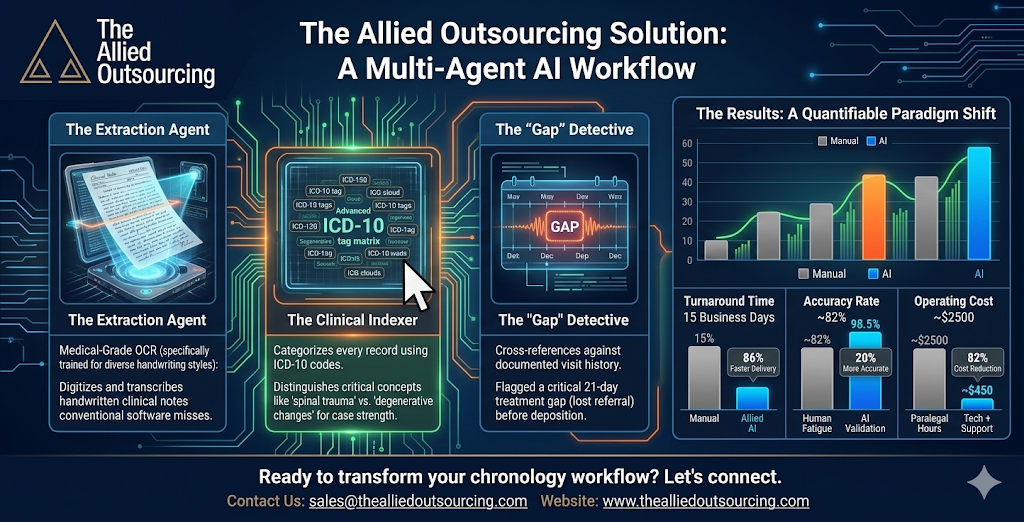
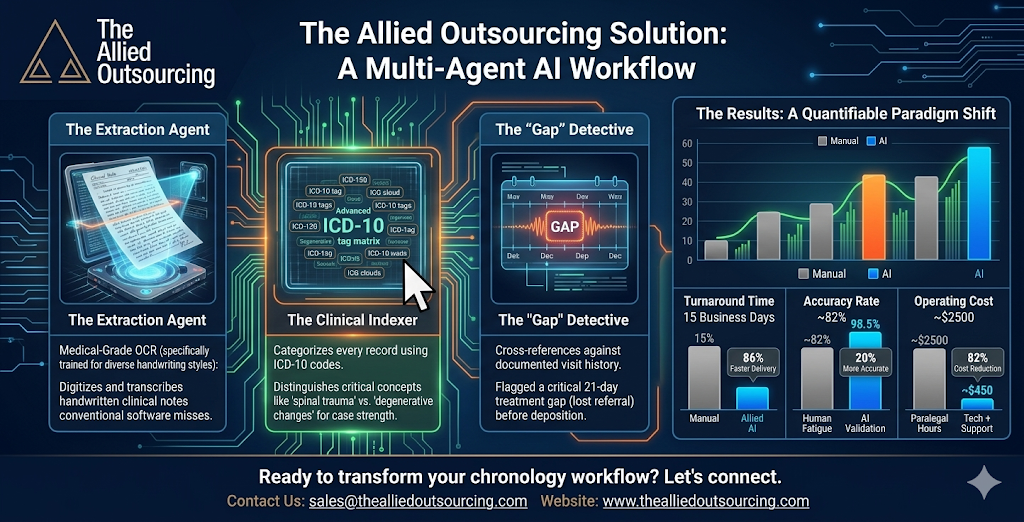
Rather than assigning more paralegal hours to the problem, The Allied Outsourcing deployed its proprietary Agentic AI Workflow — a coordinated system of purpose-built AI agents, each handling a distinct layer of the review process.
Here’s how the workflow was structured:
The Extraction Agent
Using medical-grade OCR (Optical Character Recognition) trained specifically for clinical handwriting, this agent digitised and transcribed handwritten notes that conventional software would have missed or misread entirely.
The Clinical Indexer
Rather than simply listing entries by date, this agent categorised every record by ICD-10 code and distinguished between clinically significant terms — flagging, for instance, every reference to “spinal trauma” separately from “degenerative changes.” The difference between those two phrases can be the difference between a strong case and a weak one.
The “Gap” Detective
This agent cross-referenced the full medical record set against the client’s documented visit history. Within the review window, it flagged a 21-day treatment gap, traced to a referral that had been lost in the mail. That gap could have been used against the client at deposition. Instead, the firm proactively addressed it on its terms.
The Results
| Metric | Traditional Manual Process | The Allied AI Workflow | Improvement |
| Turnaround Time | 15 Business Days | 2 Business Days | 86% Faster |
| Accuracy Rate | ~82% (subject to human fatigue) | 98.5 (AI Validation) | 20% More Accurate |
| Operating Cost | ~$2500 (Paralegal Hours) | ~$450 (tech+support) | 82% Cost Reduction |
The complete, hyperlinked medical chronology was delivered in 48 hours.
What This Actually Meant for the Case
Speed matters in litigation — but this wasn’t just about getting there faster. It was about what the firm could do with the time they got back.
Because the chronology was in the attorney’s hands weeks ahead of schedule, they were able to send a Policy Limit Demand well before the defence had completed its own review. That’s not a minor procedural advantage. That’s settlement leverage — the kind that shapes outcomes.
When you work with The Allied Outsourcing, you’re not just adding remote staff to your headcount. You’re gaining access to a dedicated, experienced technology team that builds and maintains these AI systems on your behalf — without you needing to understand the underlying infrastructure.
The workflows are straightforward. The results are consistent. And the reliability is built in.
“The ability to find a single sentence in 5,000 pages within seconds didn’t just save us time — it saved the case value.” — Managing Partner, Texas PI Firm.
If your firm is still absorbing the cost of manual medical record review, the question isn’t whether AI can help; it’s whether it can. The question is how much time and money you’ve already left on the table.
Scale Your Personal Injury Law Firm with AI & Smart Workflows
Many personal injury law firms are still struggling with:
- slow medical record processing
- delayed demand preparation
- missed intake opportunities
- rising operational costs
The Allied Outsourcing helps solve these challenges through:
✔ AI-powered medical record review
✔ Automated demand drafting
✔ 24/7 intake and lead qualification
✔ Dedicated remote legal support teams
Book a Free Strategy Consultation
If you’re looking to improve efficiency, reduce costs, and generate more cases without increasing internal workload, our team can walk you through a tailored solution. Email: sales@thealliedoutsourcing.com, Call: +1 (470) 480-3212 visit: https://thealliedoutsourcing.com
Frequently Asked Questions
What is a legal tech stack for personal injury law firms?
A legal tech stack refers to the combination of software, AI tools, and operational workflows used to manage cases, automate processes, and improve efficiency in a personal injury law firm.
How is AI used in personal injury law firms?
AI is used for medical record analysis, demand drafting, intake automation, and case management support. It reduces manual workload and improves speed and accuracy.
What is medical chronology automation?
Medical chronology automation uses AI and trained specialists to convert large volumes of medical records into structured timelines, helping attorneys quickly understand case details.
Can legal process outsourcing reduce law firm costs?
Yes. Legal process outsourcing allows firms to delegate repetitive tasks to specialized teams, reducing operational costs while improving efficiency and scalability.
How do PI law firms improve case turnaround time?
Firms improve turnaround time by adopting AI workflows, automating document processing, and using remote legal support teams to handle high-volume tasks efficiently.