


The gap between a potential client clicking your ad and signing a retainer has never been more expensive to close.
For U.S. personal injury firms, cost-per-lead keeps climbing — yet conversion rates often stay flat. The culprit isn’t your marketing. It’s what happens after the click: slow intake responses, manual medical record requests, and in-house staff buried in pre-litigation paperwork before a case ever gets momentum.
The firms pulling ahead in today’s competitive personal injury legal market aren’t working harder. They’re working with smarter infrastructure — specifically, a Specialised Remote Support Extension Team that combines human expertise with purpose-built AI.
That’s what we do at The Allied Outsourcing. We’re not a generic outsourcing vendor. We’re a high-touch operational partner with deep roots in U.S. PI law and a tech team that builds custom AI agents from the ground up — the kind that can realistically cut your personal injury firm’s operating costs by 50% or more.
Here’s how it works.
Table of Contents
PI Growth Blueprint: How Top Firms Turn Clicks into Signed Cases
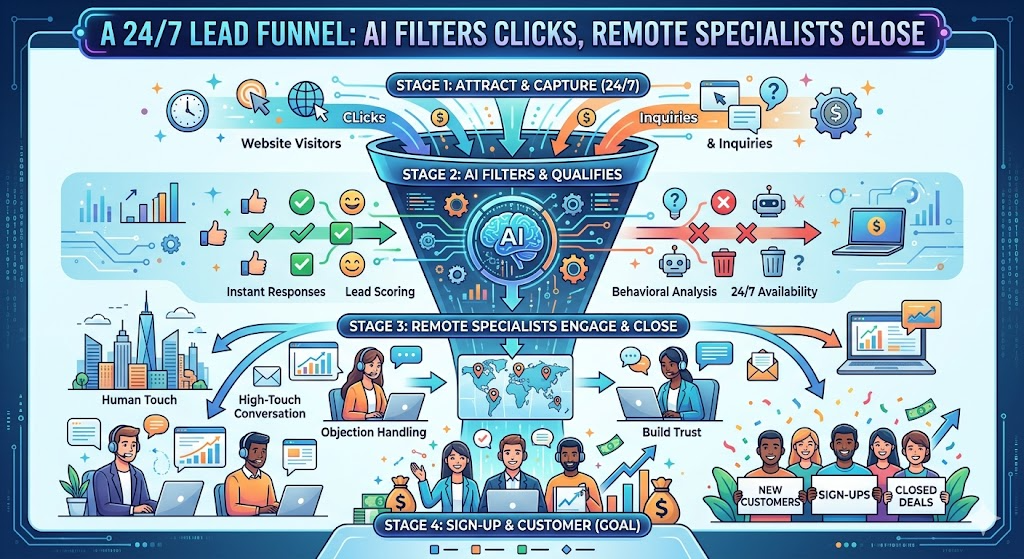
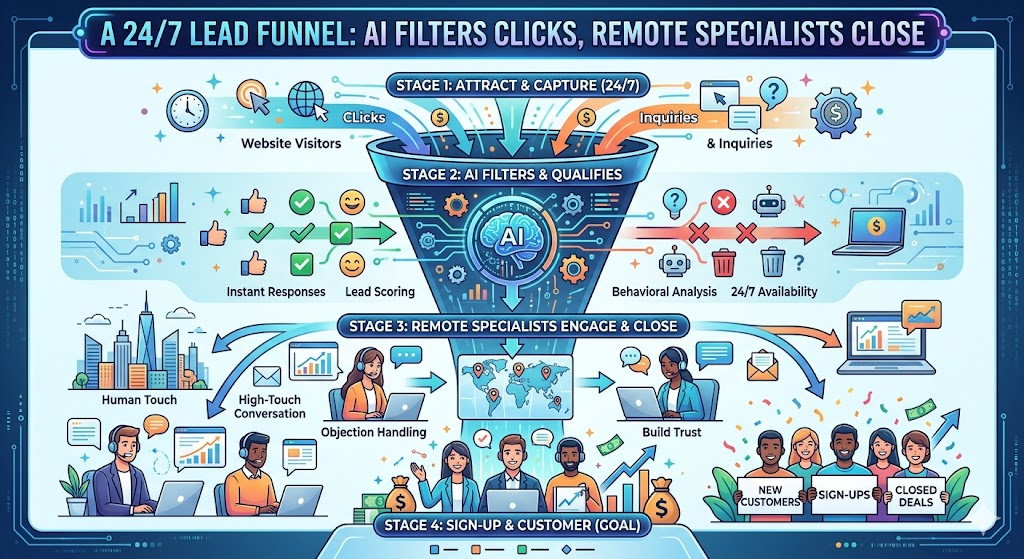
A few years ago, the rule was simple: be first to call. Research still backs this up — around 78% of accident victims hire the first attorney they meaningfully connect with.
But “connecting” looks different now. In 2026, that first touchpoint is often an AI-powered legal intake agent rather than a receptionist. The question is whether your AI is actually doing useful work — or just collecting a name and number.
The AI intake agents for personal injury firms our tech team builds go well beyond basic chatbots. They:
- Qualify leads using jurisdiction-specific intake logic — so your team isn’t chasing cases that don’t fit your practice
- Analyse sentiment to surface high-priority leads, particularly catastrophic injury cases that require immediate attention
- Schedule consultations directly into your CMS (Clio, MyCase, and others) in real time, without anyone manually touching a calendar
And here’s what makes the hybrid AI + human intake model work: our remote intake specialists stay in the loop alongside the AI. When a conversation calls for real empathy — a scared client, a confused family member — a human steps in. The AI handles the data; the people handle the relationship.
The result is genuine 24/7/365 PI law firm coverage without the cost or complexity of a U.S.-based night shift.
2. The Pre-Litigation Phase: Where Profit Margins Usually Go to Die
If intake is where cases are won or lost in the first minute, the pre-litigation workflow for personal injury attorneys is where they’re won or lost over the next six months.
Medical record retrieval and chronology drafting are notorious time-sinks in PI practice management. Attorneys end up doing administrative follow-up rather than developing a litigation strategy. Backlogs build. Cases stall.
A Real Example: 35% More Conversions for a Florida PI Firm
A mid-sized Florida firm came to us with a six-month backlog in medical record summaries. Their attorneys were spending roughly 15 hours a week chasing records and coordinating follow-ups — time that should have been going toward strategy and client communication.
What we did: We deployed a dedicated remote legal support extension team to take over the entire medical record workflow, end to end.
The tech layer: Our AI agents automatically scrubbed incoming records — extracting dates of service, provider names, and ICD-10 codes — so the team didn’t have to start from scratch on every file.
What happened:
- 40% reduction in case cycle time
- 50% drop in support staff costs
- 25% more cases handled — without a single new local hire
The backlog cleared. The attorneys got their time back. The firm grew.
Improve Personal Injury Law Firm Lead Conversion
If your firm is struggling with personal injury law firm lead conversion, the issue is not your marketing — it’s your intake system and backend workflow.
The Allied Outsourcing helps you:
✔ implement law firm intake automation
✔ improve personal injury law firm marketing ROI
✔ deploy AI in personal injury law firms
✔ increase qualified case conversions
Book a strategy call to identify your conversion gaps
3. AI Agents for Personal Injury Firms: Practical Productivity, Not Just a Buzzword
“AI” gets thrown around a lot in legal technology for PI attorneys. What we’re describing is something more specific: AI Agents for Personal Injury Firms — autonomous software built to handle multi-step legal workflows, not just answer simple questions.
Here’s what that looks like in practice for a U.S. personal injury law firm operations context:
- Demand Letter Drafting: Our agents analyse medical chronologies and policy limits to produce initial demand letters that are roughly 90% ready for attorney review. Your attorneys refine and sign off — they don’t start from a blank page.
- Treatment Gap Analysis: The AI flags missing records or treatment gaps (e.g., “Client missed PT for three weeks”) and alerts our remote team to proactively follow up. Nothing falls through the cracks.
- Discovery Categorisation: Thousands of pages tagged and organised in hours, not weeks.
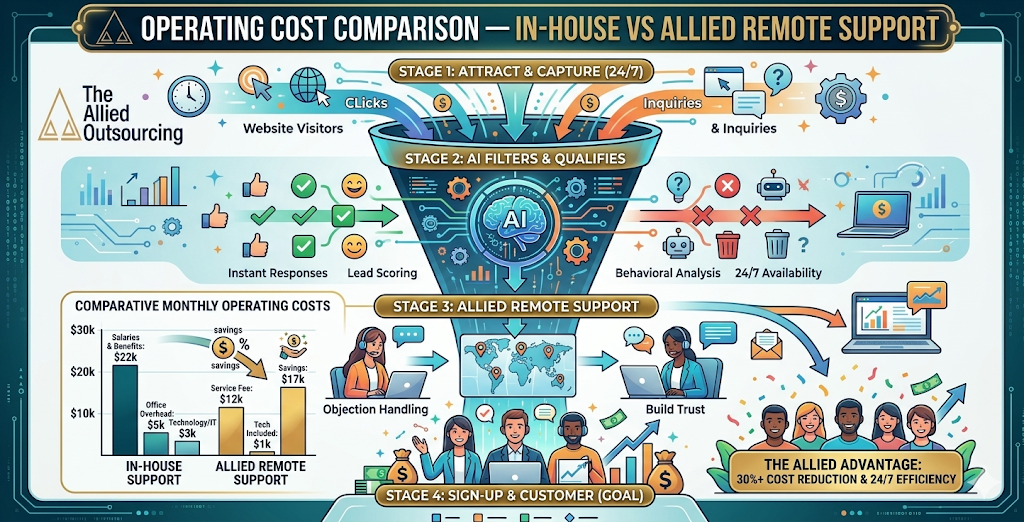
To put the ROI of AI-powered legal outsourcing in concrete terms:
| Metric | Traditional In-House | Allied Outsourcing (AI + Remote) |
| Cost Per Case Managed | $2,500+ | $1,200 or less |
| Intake Response Time | 5–15 minutes | Under 30 seconds |
| Medical Summary Accuracy | Variable | 99.9% (AI-scrubbed + human-verified) |
| Scalability | Slow (hire and train) | Immediate (plug and play) |
4. What Cutting Costs by 50% Actually Looks Like for a PI Firm
The financial case for outsourcing U.S. personal injury law firm operations is straightforward, but it’s worth spelling out.
Traditional U.S.-based support staff comes with salaries, benefits, office space, hardware, and real turnover risk. When caseload spikes, you hire. When it dips, those fixed costs don’t move.
Our model converts that fixed overhead into a variable, scalable legal operations investment:
- No office or infrastructure costs for support staff
- No benefits or HR overhead
- Talent that’s rigorously trained in U.S. PI law — including ERISA liens, state-specific PIP regulations, and the nuances that matter in your jurisdiction
This isn’t about offshoring generic tasks. It’s about having specialist remote legal support staff who understand your work, doing it at a fraction of the cost.
For firms asking “how do I reduce overhead without sacrificing quality in my PI practice?” — this is the answer modern U.S. personal injury law firms are increasingly turning to.
5. Security and Reliability: The Foundation, Not a Footnote
We know that data security for legal outsourcing isn’t optional in legal work — and it shouldn’t be treated as a checkbox.
A few things we want to be clear about:
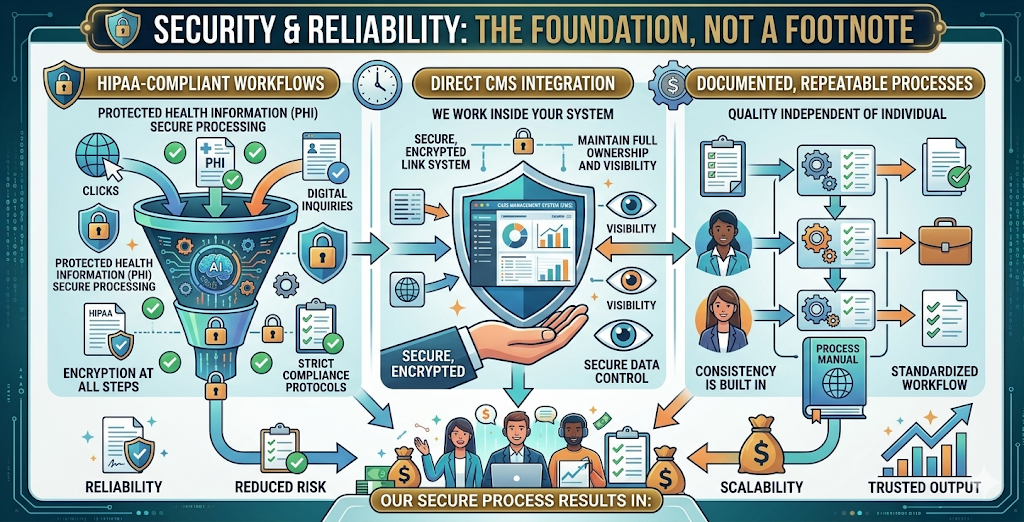
- HIPAA-Compliant Workflows: All Protected Health Information is handled in accordance with strict HIPAA compliance protocols for legal vendors at every step of our process.
- Direct CMS Integration: We work inside your case management system. You maintain full ownership and visibility of your data — always.
- Documented, Repeatable Processes: Our workflows are standardised so that quality doesn’t depend on which team member handles a file. Consistency is built in, not hoped for.
What a Reimagined Personal Injury Firm Actually Looks Like
Pull back and picture what becomes possible when your PI law firm infrastructure is working the way it should:
- Every new lead gets a response in seconds, not minutes
- Demand letters go out weeks earlier in the case cycle
- Operating costs come down meaningfully — not incrementally
- Your attorneys spend their time on litigation strategy and client relationships, not administrative follow-up
This isn’t a vision for some future version of your firm. It’s what the firms we partner with are experiencing right now.
Across the industry, the question is no longer “should personal injury firms use AI and outsourcing?” — it’s “which firms will implement it before their competitors do?”
Scale Your Personal Injury Law Firm Without Hiring More Staff
If any of this sounds like the kind of infrastructure your firm has been looking for, we’d genuinely love to talk through what it could look like for your specific situation.
Schedule a Strategy Call with The Allied Outsourcing → No pressure, no hard pitch — just a real conversation about where your firm is and where you want it to go.
Email: sales@thealliedoutsourcing.com | Contact: Ashok V. Joshi | Ph: +1 (470) 480 3212 | Website: The Allied Outsourcing
Frequently Asked Questions
What is legal process outsourcing (LPO) for personal injury firms?
Legal process outsourcing (LPO) for personal injury firms means partnering with a specialised external team — like The Allied Outsourcing — to handle support-level workflows such as intake management, medical record retrieval, chronology drafting, and demand letter preparation. Unlike generic outsourcing, PI-focused LPO providers are trained in U.S. personal injury law, ERISA liens, and jurisdiction-specific nuances that matter to your case outcomes.
How does AI-powered intake work for a PI law firm?
AI-powered intake for personal injury firms uses agentic AI — purpose-built software that qualifies leads using jurisdiction-specific logic, analyses sentiment to prioritise high-value cases, and schedules consultations directly in your CMS in real time. At The Allied Outsourcing, our AI is always paired with human specialists who step in when emotional intelligence and empathy are required, giving you the speed of automation and the warmth of a real person.
Can outsourcing really reduce a personal injury firm’s operating costs by 50%?
Yes — and we’ve documented it. The savings come from eliminating U.S.-based overhead (salaries, benefits, office space, hardware, and HR management) and replacing fixed costs with a scalable model. One Florida PI firm we worked with reduced support staff costs by 50% while simultaneously handling 25% more cases with no new local hires.
How long does it take to clear a medical records backlog with your team?
It varies by volume, but firms typically see dramatic backlog reduction within the first 30–60 days of onboarding. Our remote extension team handles the entire medical record workflow — from retrieval to AI-scrubbed chronologies — while our AI automatically extracts dates of service, provider names, and ICD-10 codes to accelerate accuracy.
Is outsourcing legal work to a remote team HIPAA-compliant?
At The Allied Outsourcing, all workflows involving Protected Health Information (PHI) are designed and executed in strict accordance with HIPAA compliance standards. We integrate directly into your existing CMS, meaning your firm maintains full data ownership and visibility at all times. We’re happy to walk through our security protocols on a strategy call.
What CMS platforms does The Allied Outsourcing integrate with?
Our AI and remote teams work natively with major legal CMS platforms including Clio, MyCase, and others. Integrations are built to fit your existing infrastructure — we work in your system, not around it.
How is The Allied Outsourcing different from a typical legal staffing agency or LPO?
Most legal staffing agencies place general-purpose virtual assistants. Most LPOs handle high-volume, low-complexity tasks. The Allied Outsourcing is a specialised remote support extension team with deep training in U.S. personal injury law, combined with a proprietary AI layer built specifically for PI workflows. The result is senior-level accuracy at a fraction of in-house cost — something neither a staffing agency nor a generic LPO can match.
Do I need to change my current case management system to work with you?
No. We integrate into your existing CMS and workflow. You don’t need to overhaul your tech stack. Our goal is to be a seamless extension of your team — visible in your system, invisible in terms of disruption.