


Table of Contents
The personal injury legal industry is entering a major operational shift.
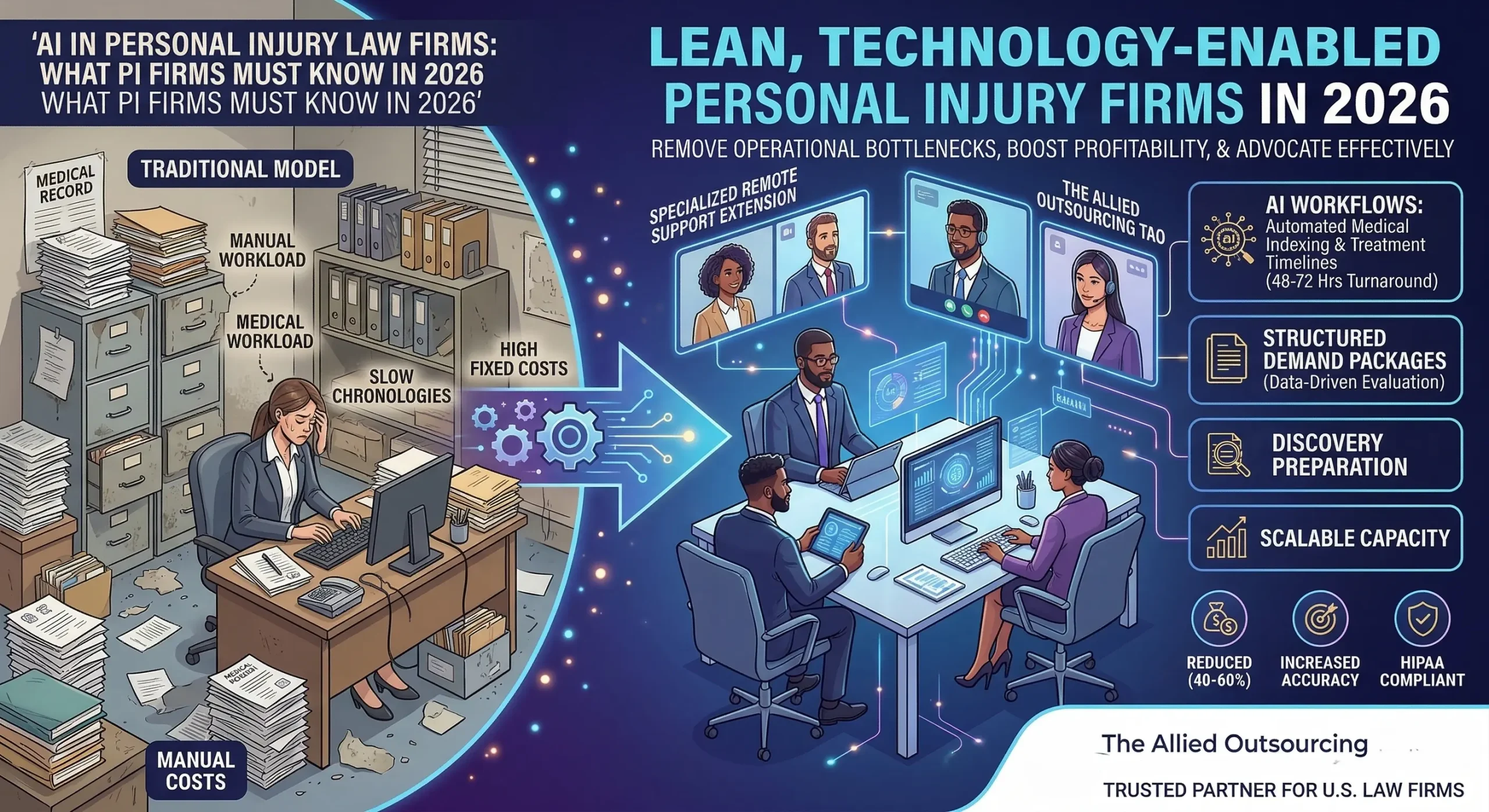
For decades, most personal injury law firms relied on large internal teams to handle medical records, chronologies, discovery preparation, and demand packages. But in 2026, that traditional model is becoming increasingly difficult to sustain.
Rising labor costs, growing case volumes, and complex medical documentation are forcing firms to rethink how their operations work.
A new model is emerging: lean, technology-enabled personal injury firms supported by AI-powered workflows and specialized remote legal teams.
These firms are not replacing legal expertise with technology — they are using automation and legal process outsourcing to remove operational bottlenecks so attorneys can focus on strategy, litigation, and client advocacy.
Understanding this shift is becoming essential for any PI firm that wants to remain competitive.
The End of Manual Medical Chronologies in Personal Injury Cases
One of the largest operational bottlenecks in personal injury litigation has always been medical record review and chronology preparation.
Paralegals often spend days — sometimes weeks — reviewing large volumes of medical records that include:
- Emergency room documentation
- Chiropractic treatment notes
- MRI and radiology reports
- Billing ledgers and ICD-10 codes
- Handwritten physician notes
In many personal injury cases, medical files can easily exceed 500–1,000 pages.
Traditional manual review creates several challenges:
- Slow case preparation
- Increased risk of missed details
- Delays in demand package drafting
- Limited capacity to scale case volume
Today, AI-assisted medical record analysis is transforming this process.
Modern AI workflows can:
- Automatically extract medical events from records
- Identify treatment timelines across multiple providers
- Detect gaps in treatment that could affect case value
- Highlight potential “value drivers” such as surgical recommendations or chronic pain indicators
Instead of replacing legal professionals, these tools allow medical chronology specialists and legal analysts to focus on interpretation rather than document sorting.
For personal injury firms handling large caseloads, this dramatically improves case preparation speed and accuracy.
From Traditional Outsourcing to Remote Legal Support Extensions
The term “outsourcing” used to create concern within many law firms.
Older outsourcing models often involved disconnected teams with limited understanding of the personal injury litigation process.
However, the modern approach in Personal Injury has evolved significantly.
Leading PI firms are now adopting a Remote Legal Support Extension model — specialized external teams that function as an operational extension of the firm.
These teams typically support tasks such as:
- Medical record organization and indexing
- Medical chronology preparation
- Demand package drafting
- Discovery document preparation
- Case management support
- Legal administrative tasks
Unlike generic outsourcing providers, specialized legal process outsourcing teams are trained specifically in personal injury case workflows, lien management, medical terminology, and litigation timelines.
When integrated properly with the firm’s case management systems such as Clio or Filevine, these teams operate almost seamlessly with internal staff.
This allows firms to increase capacity without increasing fixed operational overhead.
The Economic Reality Facing Personal Injury Law Firms
Operational costs for personal injury firms in the United States have increased significantly over the past decade.
Major cost drivers include:
- Recruitment and training of paralegals
- Rising salaries for experienced legal staff
- Technology infrastructure and software licensing
- Office overhead and administrative management
For firms trying to scale, these expenses can create significant financial pressure.
Many PI firms are now adopting hybrid operational models where high-intensity, repetitive tasks are handled by specialized legal process outsourcing for personal injury law firms.
This allows firms to reduce operational costs while improving turnaround times.
| Expense Category | Traditional In-House Model | Remote Support Extension Model |
| Talent Acquisition | Recruitment, training, benefits | Pre-trained PI support specialists |
| Technology Infrastructure | Separate AI, OCR and storage tools | Integrated workflow systems |
| Management Overhead | Attorneys managing large internal teams | Managed processes with built-in quality control |
| Chronology Turnaround | 2–3 weeks average | 48–72 hours with automated workflows |
For many firms, this model creates a significant improvement in scalability and operational efficiency.
AI-Assisted Demand Packages and Discovery Preparation
Another area rapidly evolving is demand package preparation.
Demand letters have always been one of the most important components of a personal injury case. However, compiling them traditionally requires extensive manual work, including:
- Reviewing treatment summaries
- Extracting billing information
- Identifying ICD-10 codes
- Organizing medical timelines
- Drafting narratives describing pain and suffering
Insurance companies are increasingly using data-driven evaluation models when reviewing demand packages.
As a result, well-structured, data-supported demand packages can have a meaningful impact on negotiations.
AI-assisted workflows can support attorneys by:
- Extracting billing data from medical records
- Organizing treatment timelines automatically
- Highlighting important medical findings
- Generating structured demand drafts
However, human expertise remains essential.
Experienced legal professionals review and refine AI-generated outputs to ensure:
- accuracy of medical interpretation
- compliance with litigation strategy
- persuasive narrative for settlement negotiations
This combination of automation and human legal insight allows firms to produce demand packages more efficiently while maintaining high-quality standards.
Data Security, Compliance, and Human Oversight
With increased use of automation and AI in legal operations, data security and ethical considerations have become critically important.
Personal injury firms handle highly sensitive information, including:
- protected health information (PHI)
- medical records
- insurance documentation
- personal client data
Responsible technology use requires strict compliance with privacy regulations such as HIPAA and other applicable legal standards.
Modern legal workflow systems often implement a Human-in-the-Loop verification model.
In this structure:
- AI tools handle repetitive administrative processes
- human specialists verify medical summaries and legal documentation
- final outputs are reviewed before use in litigation or negotiations
This layered approach ensures firms gain the speed advantages of automation without sacrificing accuracy or compliance.
Is Your Personal Injury Law Firm Operationally Ready for 2026?
Many firms still experience operational slowdowns caused by manual workflows.
Below is a simplified comparison of common bottlenecks and modern workflow solutions.
| Process Area | Manual Workflow Challenges | Modern Operational Approach |
| Medical Records | Paralegals manually rename and organize files | Automated indexing and document classification |
| Case Analysis | Treatment gaps discovered late in case lifecycle | Continuous medical timeline monitoring |
| Demand Preparation | Attorneys spend hours locating billing data | AI-assisted data extraction with expert review |
| Operational Costs | High fixed salary expenses | Flexible support teams aligned with case volume |
Firms that address these inefficiencies often gain significant advantages in case turnaround speed and operational scalability.
The Future of Personal Injury Law Firm Operations
The most successful personal injury firms over the next decade will likely focus their internal teams on what attorneys do best:
- litigation strategy
- client relationships
- negotiation
- trial preparation
Operational tasks such as record management, chronology preparation, document organization, and administrative workflows are increasingly supported by automation and specialized legal support teams.
This operational shift allows firms to handle more cases, reduce delays, and improve overall efficiency without compromising legal quality.
The Future of Personal Injury Law Firm Operations
The personal injury firms that will dominate the next decade are not necessarily the largest firms — they are the ones that operate faster, leaner, and smarter.
Technology and AI are rapidly transforming how personal injury cases are managed, but successful firms understand that technology alone is not enough.
The real advantage comes from combining AI-driven workflows with experienced legal support professionals who understand personal injury litigation.
By modernizing operational processes such as:
- medical record review
- medical chronology preparation
- demand package drafting
- discovery preparation
- case management support
law firms can significantly improve case turnaround time, operational efficiency, and overall profitability.
Instead of expanding internal teams and increasing overhead, many PI firms are adopting flexible operational models supported by specialized legal process outsourcing partners.
This allows attorneys to focus on what matters most — winning cases and serving clients.
See How Your Personal Injury Firm Can Scale Without Increasing Overhead
Many personal injury law firms struggle with operational bottlenecks that slow down case movement, including:
- medical record organization
- treatment timeline analysis
- demand package preparation
- administrative case management
The Allied Outsourcing helps personal injury firms solve these challenges through AI-assisted workflows and specialized PI support teams.
Our remote legal support teams work alongside your firm to help you:
✔ Organize and analyze medical records faster
✔ Prepare accurate medical chronologies
✔ Draft structured demand packages
✔ Improve case preparation efficiency
✔ Reduce operational costs while increasing case capacity
Schedule a Consultation
If your firm is exploring ways to improve operational efficiency or handle larger case volumes without increasing internal staffing, our team would be happy to discuss your workflow needs. Email: [email protected] Phone: +1 (470) 480-3212 Or visit: https://www.thealliedoutsourcing.com
Frequently Asked Questions
How is AI used in personal injury law firms?
AI is increasingly used in personal injury law firms to assist with tasks such as medical record analysis, medical chronology preparation, billing data extraction, and demand package drafting. These tools help reduce manual work and improve case preparation efficiency while attorneys maintain control over legal strategy and decision-making.
What is legal process outsourcing for personal injury law firms?
Legal process outsourcing (LPO) allows personal injury law firms to delegate operational tasks such as document review, medical record organization, discovery preparation, and legal administrative work to specialized external teams. This helps firms reduce operational costs while improving case management efficiency.
Can outsourcing medical chronologies improve case preparation?
Yes. Medical chronology preparation is one of the most time-consuming tasks in personal injury cases. Outsourcing this process to trained specialists allows law firms to receive organized treatment timelines faster, helping attorneys identify important medical events and strengthen demand packages.
How can personal injury law firms scale their operations efficiently?
Many successful PI firms scale by combining internal legal expertise with external operational support. By outsourcing repetitive tasks such as medical record management, demand drafting, and case administration, firms can handle larger case volumes without significantly increasing internal staffing costs.
Is AI safe for handling medical records in personal injury cases?
When implemented properly, AI systems used in legal workflows operate within secure environments that follow strict privacy and compliance requirements, including HIPAA regulations. Many firms use a human-in-the-loop verification model, where AI assists with data extraction while trained legal professionals review and verify the results.